Popular Pets
🐶 Dog 🐱 Cat 🐰 Rabbit 🐹 Hamster 🐾 Guinea Pig 🦜 Parrot 🦡 Ferret 🐀 Rat 🐭 Chinchilla 🦔 Hedgehog 🐟 Goldfish 🦜 Macaw
Farm & Large Animals
🐴 Horse 🐄 Cow 🐄 Highland Cow 🐷 Pig 🐑 Sheep 🐐 Goat 🐴 Donkey 🦙 Alpaca 🐐 Mountain Goat 🐔 Chicken 🦆 Duck 🦃 Turkey
Wild Animals
🐘 Elephant 🦁 Lion 🐯 Tiger 🐆 Leopard 🐺 Wolf 🐻 Bear 🐻‍❄️ Polar Bear 🦍 Gorilla 🐒 Chimpanzee 🦧 Orangutan 🦘 Kangaroo 🐾 Capybara 🦒 Giraffe 🦊 Fox 🦅 Raptor 🦉 Owl 🐧 Penguin 🦩 Flamingo 🐾 Hyena 🐾 Meerkat 🦥 Sloth 🦡 Badger 🐾 Wolverine 🐾 Armadillo
Ocean & Aquarium
🦈 Shark 🐋 Orca 🐬 Dolphin 🐋 Whale 🐋 Blue Whale 🐳 Beluga Whale 🦄 Narwhal 🐋 Bowhead Whale 🐾 Manatee 🐟 Manta Ray 🐟 Freshwater Fish 🐠 Saltwater Fish 🐴 Seahorse 🐟 Koi
Exotic & Weird
🐍 Snake 🐍 Ball Python 🦎 Bearded Dragon 🦎 Iguana 🦎 Komodo Dragon 🦎 Chameleon 🦎 Leopard Gecko 🐢 Tortoise 🐢 Snapping Turtle 🐢 Sea Turtle 🐊 Crocodilian 🕷️ Tarantula 🦎 Axolotl 🐙 Octopus 🌊 Jellyfish 🦞 Lobster 🐚 Quahog 🔬 Tardigrade
Info
About FAQ Contact
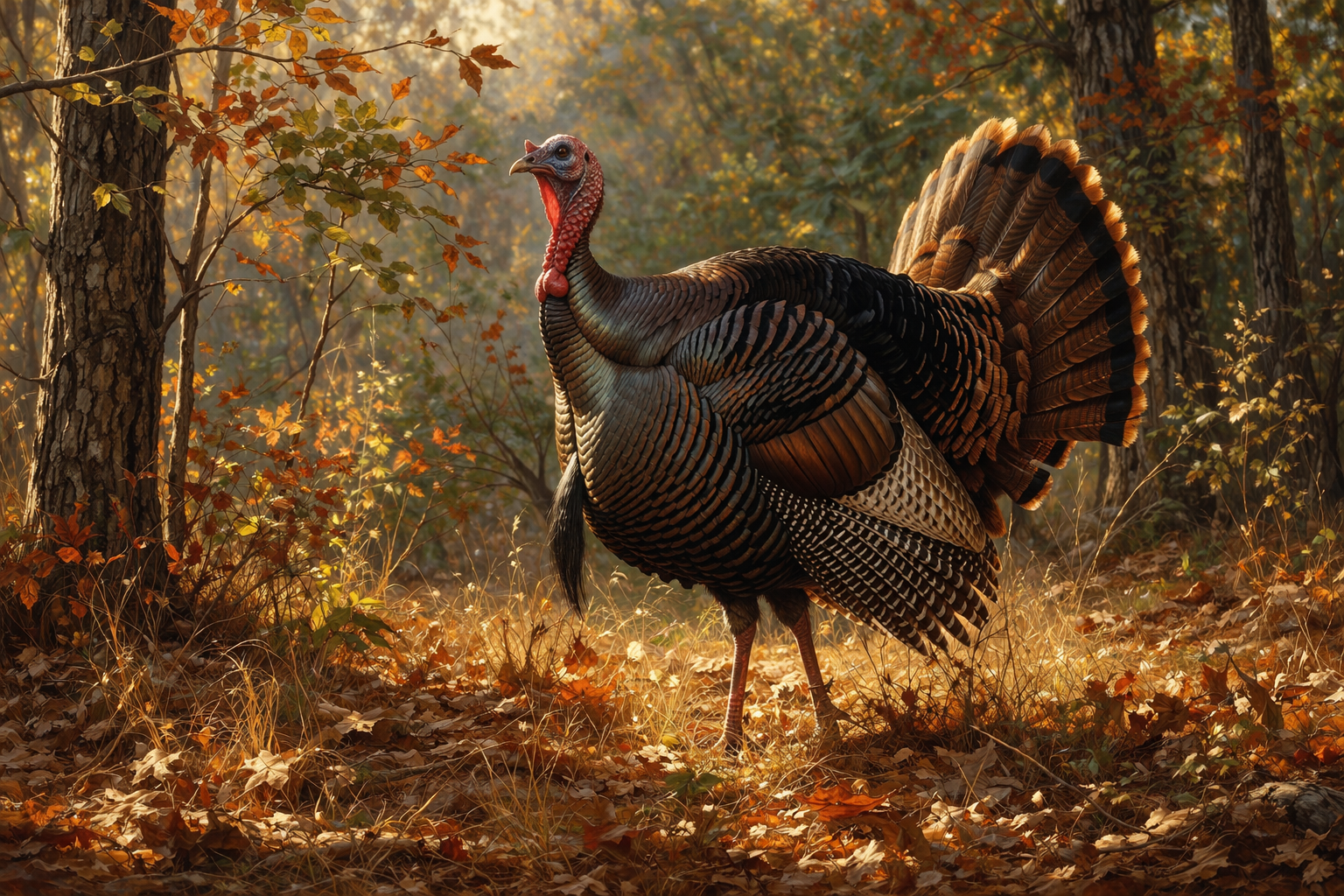
Photorealistic painting of a wild turkey displaying in an autumn forest
🦃 Farm & Large Animals

How Old Is Your Turkey in Human Years?

📅 Updated April 2026🦃 Lives: 5-12 yearsWild: 3-5 years avg

Wild turkeys can fly at 55mph and run at 25mph — yet most people have never seen one in flight. Benjamin Franklin genuinely argued the turkey would make a better national symbol than the bald eagle, calling it "a Bird of Courage." Domestic turkeys bred for Thanksgiving are so selectively modified they can no longer fly, breed naturally, or survive without human care. The wild turkey is a completely different animal.

Calculate Turkey Age →
🦃 Turkey Age in Human Years
in human years
Turkey age
Life stage
~8 yrs
Avg lifespan
🦃 What this age means

Things About Turkeys That Will Actually Surprise You

✈️ Wild Turkeys Can Fly at 55mph
Wild turkeys are capable of short bursts of flight at up to 55mph — faster than most birds people commonly see. They roost in trees at night to avoid predators, and can fly up to a mile to reach a roosting spot. This is in stark contrast to the broad-breasted domestic turkey bred for commercial production, which has been selectively modified to grow so large and so quickly that most cannot fly at all and many cannot even breed naturally, requiring artificial insemination.
🎖️ Benjamin Franklin and the Turkey
Benjamin Franklin's famous defence of the turkey as a national symbol — calling it "a much more respectable Bird" than the bald eagle and "a Bird of Courage" — was made in a private letter to his daughter in 1784, not in any official proposal. Despite the popular story, Franklin never formally proposed the turkey as the national bird. The Great Seal of the United States, which Franklin helped design, features the bald eagle. Still, Franklin's genuine admiration for the wild turkey's intelligence and tenacity reflects a real trait: wild turkeys are resourceful, socially complex birds with excellent spatial memory.
🔴 The Snood — A Turkey's Status Symbol
The fleshy protuberance that hangs over a turkey's beak is called a snood, and it functions as a genuine status signal. In male turkeys, snood length correlates with dominance — longer-snooded males win more fights, attract more females, and have higher reproductive success. Females actively choose mates with longer snoods. The snood can also change colour rapidly based on the turkey's emotional state — becoming bright red when excited or alarmed, and pale when relaxed. It is one of the more unusual examples of an honest signal of genetic quality in the animal kingdom.
🍂 Wild Turkey vs Domestic Turkey — Two Different Animals
The commercial broad-breasted white turkey — the bird most associated with Thanksgiving — has been bred so extensively for rapid breast meat growth that it bears little resemblance to its wild ancestor. Commercial turkeys reach market weight in 16-22 weeks, grow to 40+ pounds, cannot fly, cannot breed naturally, and would not survive in the wild. Wild turkeys, by contrast, are lean, athletic, intelligent birds that live 3-5 years wild and 10+ years in captivity. Heritage domestic turkey breeds — like the Bourbon Red and Narragansett — fall between these extremes: they can fly, breed naturally, and live 5-10 years.

Turkeys — The Latest Science and Research

📰 2025 — Disease
Avian Metapneumovirus Sweeps US Turkey Flocks — Hundreds of Thousands of Birds Affected

Avian metapneumovirus (aMPV) — a respiratory pathogen that resurged dramatically in US poultry in 2023-2024 — continued to affect commercial turkey flocks across multiple states in 2025. aMPV causes significant respiratory disease, egg production drops, and in severe cases mortality, particularly in turkey populations. More than 6 million birds were vaccinated against aMPV following the rollout of the first experimental autogenous vaccine in the US in late 2024.

September 2025 saw a new wave of avian influenza outbreaks, with 10 of 12 detected outbreaks occurring specifically in turkey flocks across North Dakota, South Dakota, Minnesota, and Montana. Commercial turkey producers continue to face significant disease pressure, with biosecurity protocols being reinforced across the industry.

📰 Conservation — Wild Turkey
Wild Turkey Population Recovery — One of North America's Great Conservation Success Stories

The wild turkey was nearly hunted to extinction in North America by the early 20th century, with populations reduced to fewer than 30,000 birds across fragmented habitats. Through sustained conservation efforts — habitat protection, hunting regulations, and trap-and-transfer reintroduction programmes — wild turkey populations have recovered to an estimated 7 million birds across 49 states and much of Canada and Mexico.

The wild turkey recovery is considered one of the most successful wildlife conservation programmes in North American history, alongside the bald eagle and American alligator recoveries. Wild turkeys now occupy much of their historical range and have even expanded into areas where they were historically absent. The National Wild Turkey Federation has been instrumental in this recovery, funding habitat restoration and conservation research since 1973.

Frequently Asked Questions

Wild turkeys average 3-5 years due to predation and hunting pressure, though individuals can reach 10+ years in protected areas. Domestic heritage breed turkeys live 5-10 years with good care. Commercial broad-breasted turkeys bred for Thanksgiving are slaughtered at 16-22 weeks — they are so physiologically modified for rapid growth that most could not survive much longer even with good care.
Wild turkeys absolutely can fly — short bursts at up to 55mph, and distances of up to a mile. They roost in trees at night. Commercial broad-breasted domestic turkeys cannot fly due to their extreme selective breeding for breast meat growth. Heritage domestic breeds (Bourbon Red, Narragansett, Standard Bronze) retain the ability to fly.
Wild turkeys are generally considered more intelligent than their reputation suggests — they have excellent spatial memory, navigate complex landscapes, recognise individual humans, and have sophisticated social hierarchies. Commercial domestic turkeys are sometimes characterised as dim-witted, but this likely reflects the effects of extreme selective breeding for growth rather than any inherent characteristic of the species.

More Animals on PawClocks