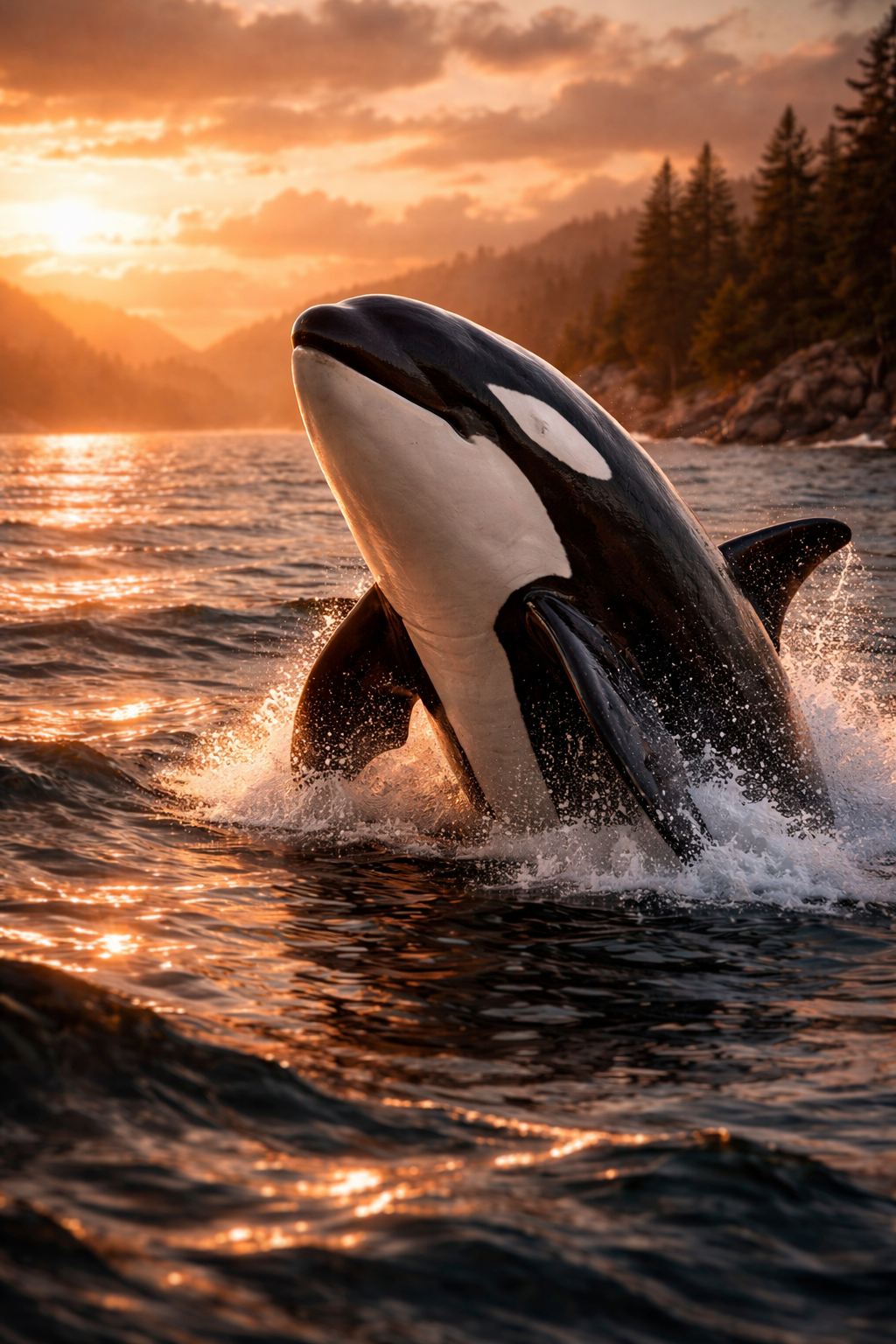
The Life Stages of an Orca
Orca life stages parallel human ones more closely than almost any other animal — long dependent childhoods, extended adolescence, decades of reproductive prime, and a post-reproductive elder phase that is unique among non-human mammals. Female orcas undergo menopause and then live for decades more — spending those years leading their pod with accumulated knowledge that measurably improves the survival of their grandchildren.
Orca Age to Human Years Conversion Table
| Orca Age | Female Orca | Male Orca | Life Stage | Key Milestone |
|---|---|---|---|---|
| Birth | Newborn | Newborn | Calf | Born tail-first; 17-month gestation |
| 2 years | ~6 yrs | ~7 yrs | Juvenile | Weaned; dialect learning begins |
| 5 years | ~12 yrs | ~14 yrs | Juvenile | Hunting skills developing |
| 10 years | ~20 yrs | ~24 yrs | Sub-adult | Dorsal fin growing; most playful phase |
| 15 years | ~28 yrs | ~34 yrs | Young adult | Sexual maturity; first calves possible |
| 25 years | ~40 yrs | ~52 yrs | Prime adult | Peak reproductive output |
| 40 years | ~55 yrs | ~68 yrs | Post-reproductive (♀) / Senior (♂) | Menopause; grandmother role begins |
| 60 years | ~70 yrs | Elder ♂ | Elder | Living memory of the pod |
| 80–90 years | ~85–90 yrs | — | Elder (record territory) | Granny (J2) estimated ~105 at death |
🐋 Male orcas live significantly shorter lives than females — average lifespan of ~29 years vs ~50 for females, with maximum ages of ~60 vs ~90. Research suggests this difference is partly due to the extreme energetic cost of maintaining a large body and large dorsal fin, and partly because males remain with their mothers their entire lives — when the mother dies, adult sons face a dramatic increase in mortality risk, suggesting that older females provide essential support even to their adult male offspring.
The Iberian Orca Story — Teenagers on the Loose
Since 2020, a story has dominated wildlife headlines worldwide: a group of orcas off the coasts of Spain, Portugal, France, and Morocco has been deliberately ramming and damaging sailboats. By late 2025, there had been over 665 documented interactions, more than 250 damaged vessels, and at least seven sunken boats. The internet went wild. The memes were magnificent. The science, it turns out, is even more interesting.
The behaviour began in May 2020 in the Strait of Gibraltar and has spread along the Iberian Peninsula. The orcas involved belong to a critically endangered subpopulation — fewer than 40 individuals total — known as the Iberian orcas, who follow the seasonal migration of Atlantic bluefin tuna.
The pattern is consistent: juvenile orcas approach slow-moving sailboats from the stern, focus on the rudder, and ram, nudge, and bite it repeatedly. In serious cases the rudder is bent, split, or torn off entirely — rendering the vessel unable to steer. The most recent incidents occurred in September and October 2025, when two boats were sunk off Portugal within hours of each other, crews rescued by nearby vessels.
Crucially: no human has ever been harmed in any of these interactions. Researchers note that if the orcas wanted to sink boats and harm people, they easily could — one expert estimated the pod could have sunk 600 boats if that were the goal.
A multinational group of orca experts released their findings in May 2024. The leading explanation: juvenile orcas started this as a playful fad — and it spread culturally through the pod by social learning.
Cetacean expert Alexandre Zerbini, who chairs the International Whaling Commission's scientific committee, described it simply: a young orca butted its head against a rudder, the rudder moved, and the orca thought "This is fun." When a piece broke off, that was even more fun. Others watched and copied. The Washington Post headline said it well: "Orcas aren't attacking boats — they're just playful teens, scientists say."
The boredom theory links the behaviour to the recovery of Atlantic bluefin tuna populations. In previous decades, when tuna were scarce, orcas spent most of their time hunting. With tuna now abundant, young orcas suddenly have free time — and are filling it the way teenagers everywhere fill free time: by finding something new and slightly destructive to do.
Researchers at Spain's Bottlenose Dolphin Research Institute proposed a different angle. Catching bluefin tuna — which can grow to 3 metres and swim in fast, dense schools — requires coordinated ramming to separate individual fish. Orcas take turns striking a tuna until it is isolated, then chase it into shallower water.
Chief biologist Bruno Díaz López observed that sailboats move in ways that closely mimic tuna — quietly, swiftly, near the water's surface. The orcas may be using boats as live training dummies. "This is like a training toy," Díaz López said. "It's a shame that we humans are in the middle of this game, but they are learning."
By 2025, scientists were expressing concern that the behaviour has moved beyond a passing fad. Naomi Rose, senior scientist at the Animal Welfare Institute, told National Geographic: "Some of these whales are growing up with the game. Unfortunately, I fear, given we're now in 2025 and they're still doing it, that it's becoming a cultural element of this population."
Orcas are one of the very few animals known to pass behaviours down through generations as cultural traditions. If boat-ramming becomes embedded in this pod's cultural repertoire — taught from older juveniles to younger ones — it may persist indefinitely, regardless of the original motivation.
Spanish and Portuguese authorities have issued navigation advisories and are exploring modifications to boat rudders (rough surfaces, pointed protrusions) to make them less appealing. Scientists recommend that boaters who encounter the pod remain calm, reduce noise, and move away slowly — making the boat as uninteresting as possible.
The scientific consensus, as of 2026: these are not attacks. They are interactions. "This is not a whale problem, it's a people problem," Rose concluded. "They live there. That's their home 24/7. We just sail through it. We're in their living room."
Things About Orcas That Will Actually Surprise You
🐋 The name "killer whale" comes from historical whalers who observed orcas killing large whales and called them "whale killers" — a description that was later inverted to "killer whale." The name has stuck despite being misleading: orcas are not whales, they are the largest dolphins, and their "killer" reputation vastly understates the sophistication and cultural complexity that actually defines them. Many scientists, conservationists, and Indigenous communities prefer the name orca, from the Latin Orcinus orca — meaning roughly "of the kingdom of the dead," a reference to their formidable predatory reputation in ancient times.
The Different Types of Orca
Orcas are so culturally and ecologically divergent that scientists recognise multiple ecotypes — populations so different in behaviour, diet, and appearance that they may represent separate species or subspecies.
| Ecotype | Range | Diet | Social Structure | Notable Trait |
|---|---|---|---|---|
| Resident (Pacific NW) | Pacific NW coast | Fish only (Chinook salmon) | Stable matrilineal pods | Never interbreeds with Transients |
| Transient / Bigg's | Pacific coast | Marine mammals only | Smaller, fluid groups | Stealth hunters; hunts in near-silence |
| Offshore | Pacific open ocean | Sharks (incl. great whites) | Large groups 25–75 | Worn teeth from shark skin |
| Antarctic Type A | Antarctic open water | Minke whales | Large groups | Classic black-and-white pattern |
| Antarctic Type B (large) | Antarctic pack ice | Seals (wave-wash hunting) | Small groups | Yellowish tinge from diatoms |
| Iberian | Strait of Gibraltar | Atlantic bluefin tuna | Small pods (~40 total) | The boat-ramming population; critically endangered |