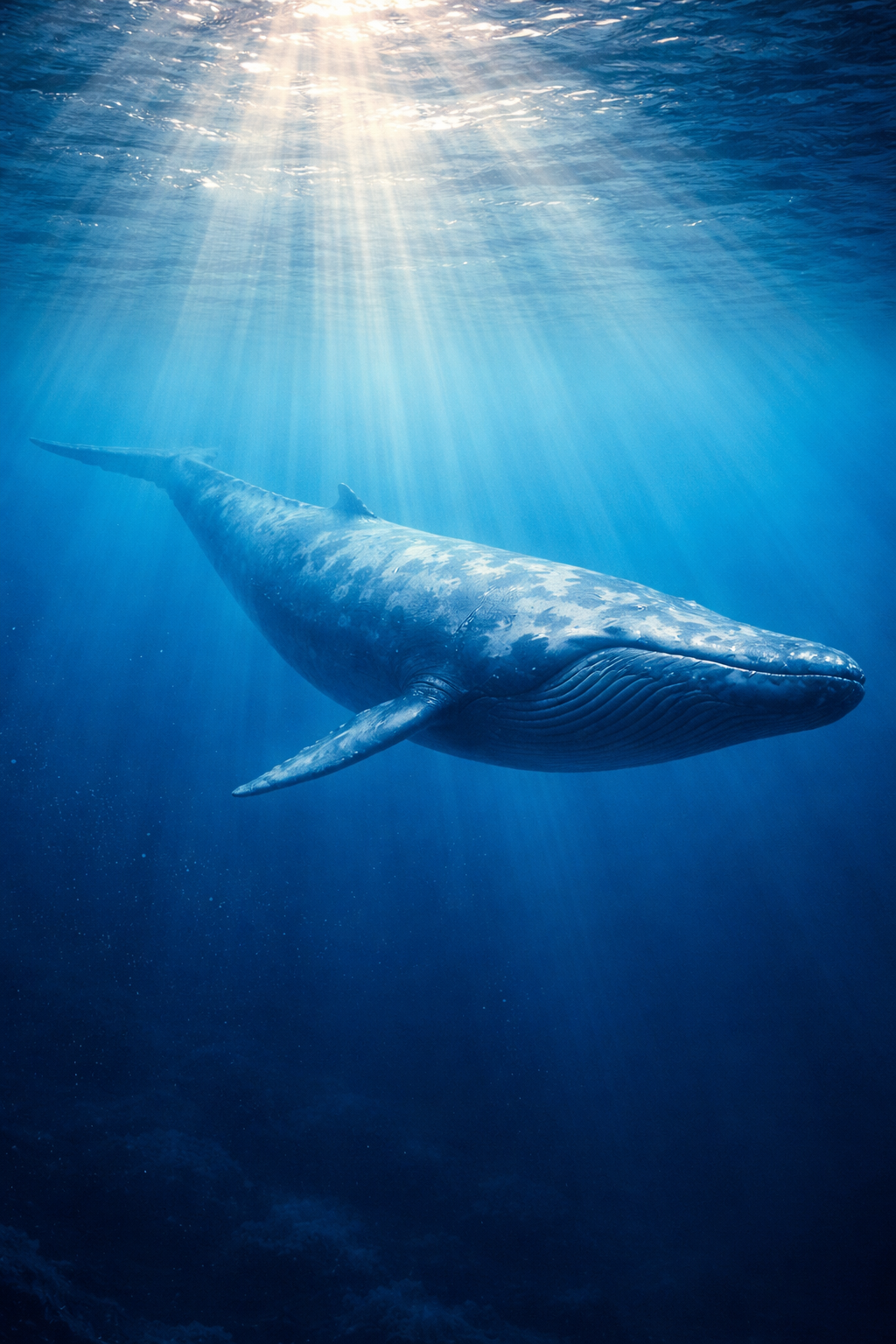
The Life Stages of a Blue Whale
Blue whales grow faster than any other animal on Earth. A calf born at 8 metres long gains roughly 90kg per day during nursing — powered by milk so rich (up to 40% fat, the consistency of cottage cheese) that it doubles its body length in just seven months. This explosive growth phase is essential: calves must be large enough to survive the journey to Antarctic feeding grounds and the attentions of orca pods before their first birthday.
Blue Whale Age to Human Years Conversion Table
| Blue Whale Age | Female | Male | Life Stage | Key Milestone |
|---|---|---|---|---|
| Birth | Newborn | Newborn | Calf | Born 8m long; gains 90kg/day |
| 7 months | ~3 yrs | ~3 yrs | Weaned | Independent; first solo migration |
| 5 years | ~10 yrs | ~11 yrs | Juvenile | Lunge-feeding skills developing |
| 10 years | ~17 yrs | ~20 yrs | Sub-adult / Young adult | Sexual maturity approaching |
| 20 years | ~30 yrs | ~35 yrs | Prime adult | Peak reproductive output |
| 40 years | ~48 yrs | ~57 yrs | Mature adult | Decades of migration routes memorised |
| 60 years | ~62 yrs | ~74 yrs | Senior | Continued breeding |
| 80 years | ~75 yrs | Elder ♂ | Elder | Exceptional longevity |
| 110 years | ~90 yrs | — | Record territory | Oldest confirmed individual |
🐋 Blue whale age is determined by counting layers in earwax plugs — accumulations of wax that build up in the ear canal throughout the whale's life, with alternating light and dark bands representing seasonal feeding cycles, similar to tree rings. These plugs also record chemical signatures of the whale's diet, stress hormones, and environmental exposures across its entire lifetime — providing a biographical record spanning decades. Research has used earwax plugs to reconstruct individual whales' life histories with remarkable precision.
Blue Whales — The Comeback Story
The blue whale's story is one of the most dramatic in conservation history — a species hunted to the edge of extinction in the 20th century that is now, cautiously, showing signs of recovery. Recent research is painting a more detailed picture of how they are faring, where threats remain, and what we are still learning about the largest animals that have ever lived.
New research from the Australian Antarctic Division, analysing two decades of audio recordings from the Southern Ocean, indicates that blue whale populations are stable or increasing. Researchers tracked the regularity and frequency of blue whale calls across vast ocean areas — finding a noticeable, growing pattern of vocalisations that suggests either a larger population or improved detection of existing animals.
The global blue whale population is now estimated at 10,000–25,000 individuals — up from approximately 2,000 at the lowest point following 20th century whaling. Antarctic blue whales alone were reduced from around 200,000 to fewer than 300 — less than 1% of pre-whaling numbers. The international ban on hunting blue whales, introduced in the mid-1960s, has allowed this slow recovery over six decades.
Scientists describe the situation as "cautiously optimistic" — recovery is real but fragile, and the species remains endangered. The rate of recovery is extremely slow for an animal that gives birth only once every 2–3 years.
A University of Washington study published in Endangered Species Research tackled a fundamental question: are Antarctic blue whales one single population, or multiple separate populations across the Southern Ocean's Atlantic, Indian, and Pacific basins?
Using historical data from the Discovery Marking Program — metal rods shot into whales during whaling and recovered at catch — combined with modern acoustic data, researchers found that Antarctic blue whales mix freely across all three ocean basins, suggesting they form a single circumpolar population rather than separate groups.
This finding matters for conservation: it means the Antarctic blue whale population is more interconnected than previously thought, but also that threats in one part of the Southern Ocean affect the entire population. The research also found that only one song type has ever been recorded among Antarctic blue whales — consistent with a single interbreeding population sharing a common culture.
A major global study from Flinders University, published in Animal Conservation, took stock of blue whale populations worldwide and found that while recovery is underway, multiple serious threats persist.
Ship strikes — collisions between large vessels and whales — are a growing concern, particularly in areas like the Galapagos where tourist vessel traffic has increased sharply. Because blue whales spend time at the surface to breathe and can be slow to detect approaching ships, strikes cause significant mortality. A separate November 2024 study quantified ship collision risk for blue, fin, humpback, and sperm whales globally, identifying critical overlap zones between major shipping lanes and whale habitat.
Climate change is altering krill distribution across the Southern Ocean — the foundation of the blue whale's food supply. As ocean temperatures rise, krill concentrations shift poleward, potentially disrupting the migration routes and feeding patterns that blue whales have followed for millennia. The Flinders researchers called for national management bodies to minimise human activities in blue whale habitat within their jurisdictions, including vessel speed restrictions and rerouting in critical feeding areas.
One of the strangest ongoing stories in blue whale science: their songs are getting lower in frequency — a shift documented across every ocean basin since the 1960s. The change is gradual but measurable and consistent worldwide, which rules out simple random variation.
The leading hypothesis is that it reflects population recovery: as whale density increases, males may be able to find mates at shorter distances, reducing the need for extreme long-range calls and allowing a shift toward lower, less energetically costly frequencies. Another hypothesis links it to changing ocean noise levels from shipping. What makes this story remarkable is that the shift appears to be happening across all populations simultaneously — suggesting a global-scale phenomenon that researchers are still working to fully understand.
Things About Blue Whales That Will Actually Surprise You
🐋 A blue whale calf grows at one of the fastest rates of any animal — gaining approximately 90kg per day during its 7-month nursing period, powered by milk with up to 40% fat content (human milk is around 4% fat). By weaning, the calf has grown from 8 metres to approximately 16 metres in length — doubling in size in less than a year. This explosive growth is essential: the calf must be large enough to survive its first migration to Antarctic feeding grounds and withstand the attention of orca pods that specifically target calves. The mother loses up to 25% of her body weight during this nursing period.
Blue Whale vs Other Large Animals
Numbers alone don't convey the scale of a blue whale. Here's how it compares to other large animals and familiar reference points.
| Animal / Object | Length | Weight | Note |
|---|---|---|---|
| Blue Whale | Up to 33m | Up to 190 tonnes | Largest animal that has ever lived |
| Fin Whale | Up to 27m | Up to 74 tonnes | Second largest animal; also recovering from whaling |
| Sperm Whale | Up to 20m | Up to 57 tonnes | Largest toothed predator; deepest diving whale |
| Orca | Up to 9m | Up to 5.4 tonnes | Apex predator; hunts blue whale calves |
| Patagotitan (largest dinosaur) | ~37m | ~70 tonnes | Longer but only ~37% of blue whale's weight |
| African Elephant | ~6m | ~6 tonnes | Blue whale's tongue weighs as much as one elephant |
| Boeing 737 | ~33m | ~80 tonnes (loaded) | Similar length; less than half the weight |