Popular Pets
🐶 Dog 🐱 Cat 🐰 Rabbit 🐹 Hamster 🐾 Guinea Pig 🦜 Parrot 🦡 Ferret 🐀 Rat 🐭 Chinchilla 🦔 Hedgehog 🐟 Goldfish 🦜 Macaw
Farm & Large Animals
🐴 Horse 🐄 Cow 🐄 Highland Cow 🐷 Pig 🐑 Sheep 🐐 Goat 🐴 Donkey 🦙 Alpaca 🐐 Mountain Goat 🐔 Chicken 🦆 Duck 🦃 Turkey
Wild Animals
🐘 Elephant 🦁 Lion 🐯 Tiger 🐆 Leopard 🐺 Wolf 🐻 Bear 🐻‍❄️ Polar Bear 🦍 Gorilla 🐒 Chimpanzee 🦧 Orangutan 🦘 Kangaroo 🐾 Capybara 🦒 Giraffe 🦊 Fox 🦅 Raptor 🦉 Owl 🐧 Penguin 🦩 Flamingo 🐾 Hyena 🐾 Meerkat 🦥 Sloth 🦡 Badger 🐾 Wolverine 🐾 Armadillo
Ocean & Aquarium
🦈 Shark 🐋 Orca 🐬 Dolphin 🐋 Whale 🐋 Blue Whale 🐳 Beluga Whale 🦄 Narwhal 🐋 Bowhead Whale 🐾 Manatee 🐟 Manta Ray 🐟 Freshwater Fish 🐠 Saltwater Fish 🐴 Seahorse 🐟 Koi
Exotic & Weird
🐍 Snake 🐍 Ball Python 🦎 Bearded Dragon 🦎 Iguana 🦎 Komodo Dragon 🦎 Chameleon 🦎 Leopard Gecko 🐢 Tortoise 🐢 Snapping Turtle 🐢 Sea Turtle 🐊 Crocodilian 🕷️ Tarantula 🦎 Axolotl 🐙 Octopus 🌊 Jellyfish 🦞 Lobster 🐚 Quahog 🔬 Tardigrade
Info
About FAQ Contact
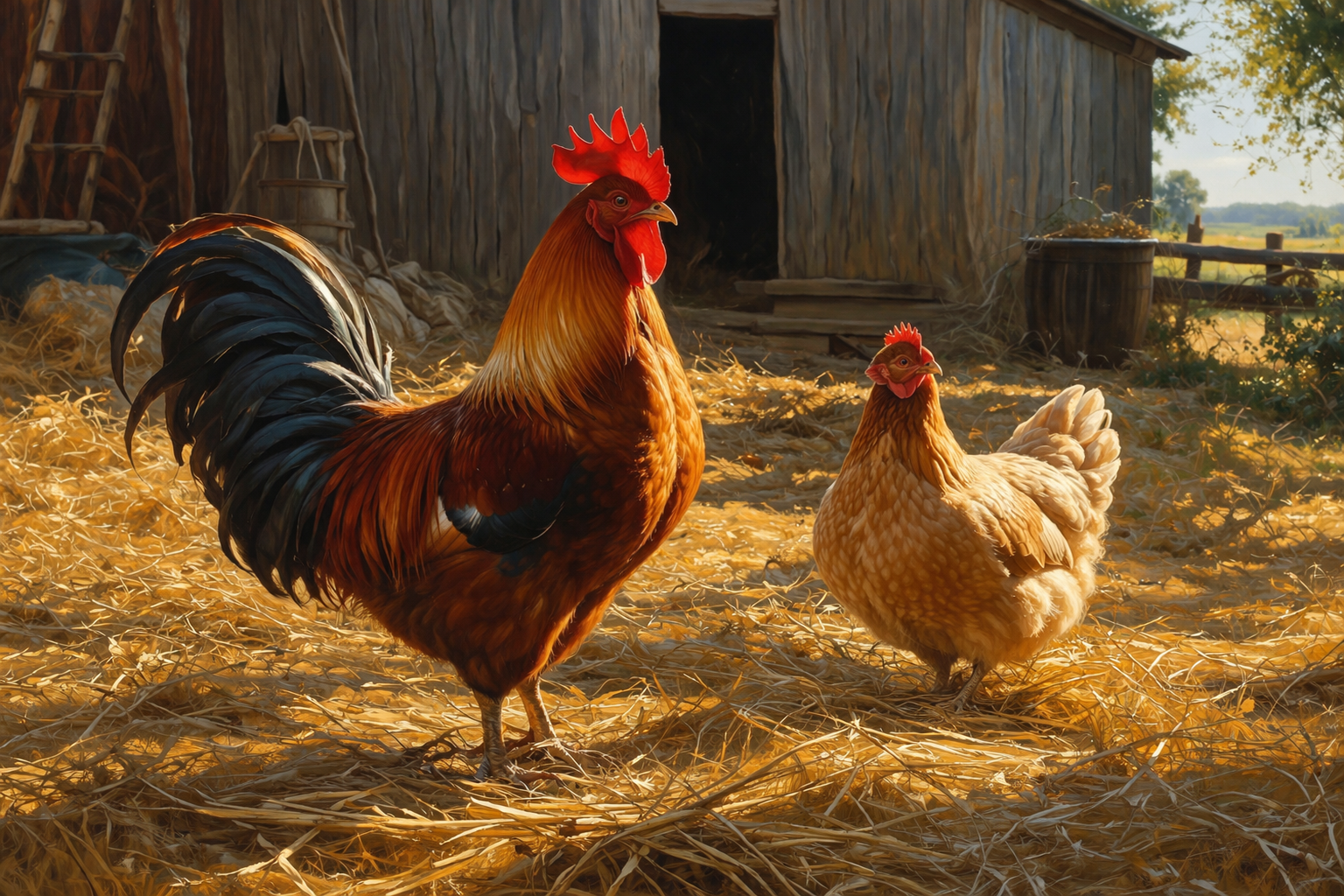
Photorealistic painting of a rooster and hen in a sunlit farmyard
🐔 Farm & Large Animals

How Old Is Your Chicken in Human Years?

📅 Updated April 2026🐔 Lives: 5-10 yearsRecord: 22 years

America has more chickens than any other animal on earth — roughly 10 for every person. Heritage breeds live 8-10 years with good care. Commercial egg-laying hybrids are typically culled at 18-24 months when their production drops. The oldest documented chicken lived 22 years. And a 2025 industry milestone: cage-free housing is now mandated for 66% of US laying hens.

Calculate Chicken Age →
🐔 Chicken Age in Human Years
in human years
Chicken age
Life stage
~7 yrs
Avg lifespan
🐔 What this age means

Things About Chickens That Will Actually Surprise You

🌍 There Are More Chickens Than Any Other Bird on Earth
With an estimated 33 billion chickens alive at any given moment — roughly 10 per person on earth — the domestic chicken is by a vast margin the most numerous bird species on the planet. More chickens exist today than all wild birds combined. This extraordinary abundance is entirely human-created: chickens were domesticated from the red junglefowl in Southeast Asia around 8,000 years ago, and selective breeding for meat and egg production over the past century has driven their numbers to a scale with no parallel in the history of vertebrate life.
🏆 The Oldest Chicken Lived 22 Years
Matilda, a Red Quill Muffed American Game hen from Alabama, holds the verified Guinness World Record for the oldest chicken ever — living to 22 years and 3 days before her death in 2006. She was a magic show chicken for much of her life, which likely contributed to her low-stress existence and exceptional longevity. The average commercial chicken lives 6-8 weeks before slaughter; a backyard heritage breed lives 5-10 years; and Matilda demonstrated that with excellent care and minimal stress, chickens can age into their third decade.
🥚 Heritage vs Commercial — A Tale of Two Lifespans
Commercial egg-laying hybrids like ISA Browns are bred to produce 300+ eggs per year — a rate that strains their reproductive systems so severely that most are culled at 18-24 months when production drops. Heritage breeds, by contrast, lay fewer eggs (150-200 per year) but maintain production longer and regularly live 8-10 years. The difference illustrates how extreme selective breeding can create a fundamental tradeoff between productivity and lifespan — a tradeoff that has significant implications for both commercial poultry welfare and backyard flock management.
🐔 Chickens Are Smarter Than You Think
Research has demonstrated that chickens possess basic self-control, arithmetic ability, and empathy. Chicks as young as a few days old can perform basic addition and subtraction. Hens show distress responses when their chicks are distressed, even when the chick is not in danger — a form of empathic response. Roosters deceive hens about food location to gain social advantage. And chickens have demonstrated object permanence — knowing that objects continue to exist when hidden — a cognitive ability that develops in human children around 7 months of age.

Chickens — The Latest Science and Research

📰 2025–2026 — Industry
66% of US Laying Hens Must Be Cage-Free by 2026 — Driven by Retailer Mandates and State Laws

A landmark shift in US commercial egg production is underway: cage-free housing is now mandated for approximately 66% of all laying hens by 2026, driven by a combination of state legislation (California's Proposition 12, Massachusetts Question 3, and similar laws in other states) and major retailer commitments from companies including Walmart, McDonald's, and most major grocery chains. As of early 2025, 38.7% of US laying hen housing was already cage-free, with the transition accelerating rapidly.

The shift represents the largest structural change in US poultry welfare in decades. Cage-free systems give hens significantly more space and the ability to express natural behaviours including perching, dust bathing, and foraging — behaviours impossible in conventional battery cages. However, researchers note that cage-free systems also present new management challenges including higher rates of disease transmission and cannibalism without proper management, underscoring that the transition requires careful implementation rather than simply removing cages.

📰 2025 — Avian Influenza
H5N5 Avian Influenza Detected in Humans for the First Time — Backyard Flocks at Risk

In November 2025, a Washington State resident became the first known human infected with H5N5 avian influenza — a strain previously not documented in people. The patient had a backyard flock of mixed domestic poultry. The case followed a wave of avian influenza outbreaks across commercial turkey and chicken flocks in multiple US states throughout 2025, affecting hundreds of thousands of birds in North Dakota, South Dakota, Minnesota, and Montana.

Backyard poultry keepers are advised to practice rigorous biosecurity: washing hands before and after handling birds, keeping flocks away from wild birds, not sharing equipment with other flocks, and monitoring birds closely for signs of illness including sudden death, respiratory distress, and drops in egg production. The USDA APHIS hotline for suspected avian influenza cases is (800) 940-6524.

Frequently Asked Questions

Heritage backyard chickens typically live 5-10 years with good care, and some individuals reach 12-15 years. The oldest verified chicken (Matilda) lived 22 years. Commercial egg-laying hybrids live much shorter lives due to the physiological strain of extreme egg production — most are culled at 18-24 months. Breed selection makes a significant difference: heritage breeds like Plymouth Rocks, Rhode Island Reds, and Orpingtons are significantly longer-lived than commercial hybrids.
Commercial hybrids bred for maximum production lay 300-320 eggs per year — nearly one per day. Heritage breeds lay 150-250 eggs per year depending on breed. All hens naturally reduce production as they age, and most stop laying reliably after 3-5 years. Egg production is also strongly influenced by day length (hens lay more in summer), nutrition, stress levels, and health.
No — hens lay eggs regardless of whether a rooster is present. A rooster is only needed to fertilise eggs for hatching chicks. The eggs you buy at a grocery store are unfertilised. For a backyard flock kept only for eggs, roosters are entirely optional and in many urban and suburban areas, roosters are prohibited by local ordinances due to noise.

More Animals on PawClocks