Six Whales, Six Completely Different Scales of Time
From a minke whale's 50-year life to a bowhead's potential 200+ years, the range across whale species is staggering — and each brings something remarkable.
200 Years of Arctic History
A bowhead whale alive today in the Arctic may have been born before the American Civil War. Here's what the world looked like across its lifetime.
The Life Stages of a Whale
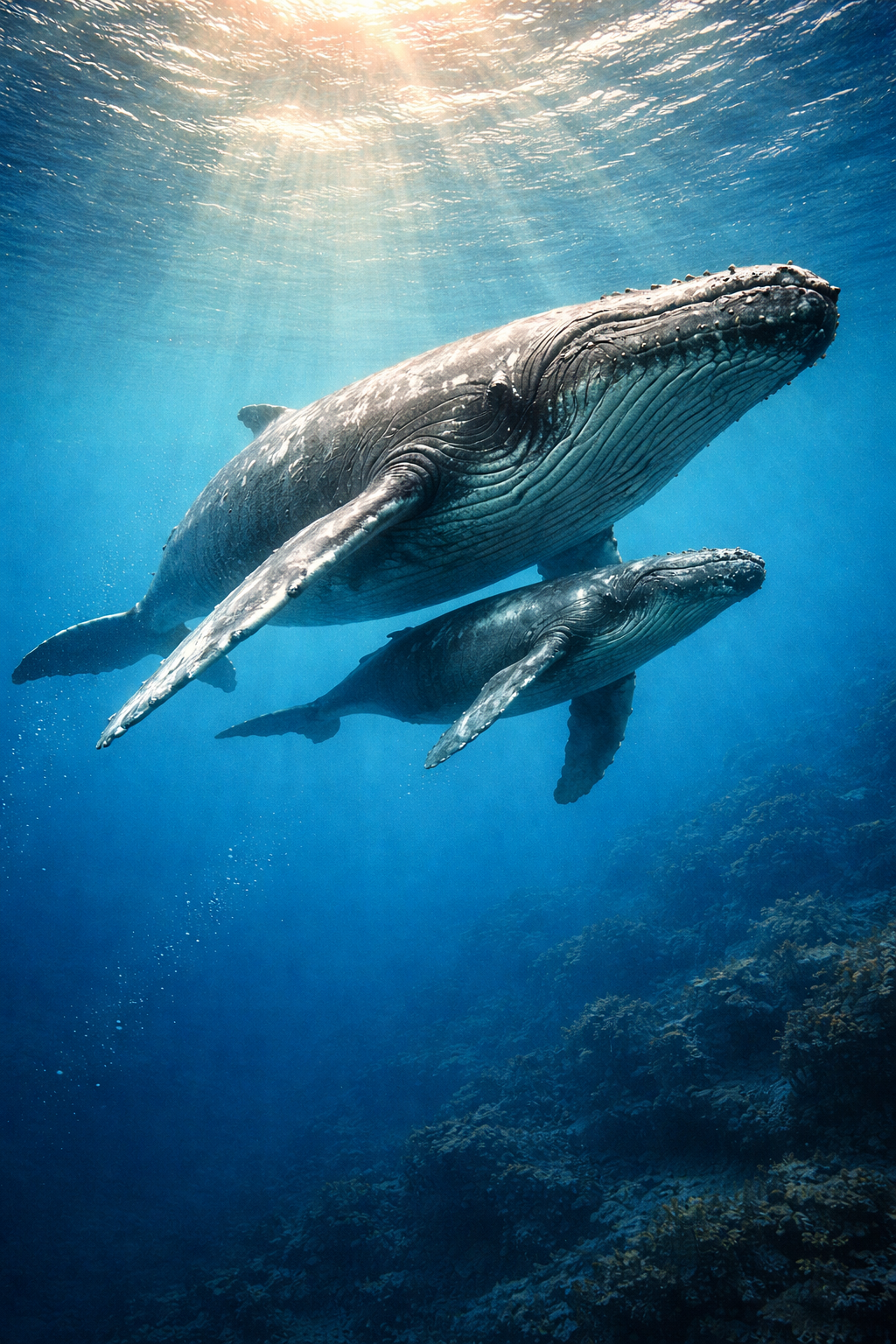
Whale life stages vary enormously by species — a bowhead whale's "juvenile" phase lasts longer than most animals' entire lifespans. The humpback mother and calf in the image above represent one of the most studied whale relationships in marine biology: humpback calves stay close to their mothers for the first year, learning migration routes that span entire ocean basins.
Things About Whales That Will Actually Surprise You
🐋 A bowhead whale killed by Inuit hunters in Alaska in 1999 was found to have a harpoon fragment from a style manufactured in New Bedford, Massachusetts around 1890 embedded in its blubber. The whale had survived the strike for approximately 130 years. This single discovery confirmed that bowhead whales can live well over a century — and possibly more than two. See also: our dedicated Bowhead Whale Age Calculator.
Whale Age to Human Years — Blue Whale Baseline
| Whale Age | Blue / Humpback / Fin | Sperm Whale | Bowhead | Life Stage |
|---|---|---|---|---|
| 5 years | ~6 yrs | ~7 yrs | ~2 yrs | Calf / Juvenile |
| 10 years | ~11 yrs | ~14 yrs | ~4 yrs | Juvenile |
| 20 years | ~22 yrs | ~28 yrs | ~8 yrs | Young Adult |
| 30 years | ~34 yrs | ~42 yrs | ~12 yrs | Prime Adult |
| 40 years | ~45 yrs | ~55 yrs | ~16 yrs | Prime/Mature |
| 60 years | ~67 yrs | ~80 yrs | ~24 yrs | Senior |
| 80 years | ~88 yrs | ~96 yrs | ~32 yrs | Elder |
| 100 years | ~108 yrs | — | ~40 yrs | Extraordinary |
| 150 years | — | — | ~60 yrs | Bowhead prime |
| 200 years | — | — | ~80 yrs | Bowhead elder |
How We Nearly Hunted the Largest Animals on Earth to Extinction
Commercial whaling represents one of the most catastrophic human impacts on any animal population in history. At its industrial peak in the 20th century, it drove multiple whale species to the edge of extinction within decades.
| Species | Pre-whaling Est. | Population Nadir | Current Est. | Status |
|---|---|---|---|---|
| Blue Whale | ~340,000 | ~360 (1960s) | ~10,000–25,000 | Endangered |
| Humpback Whale | ~150,000 | ~5,000 (1960s) | ~80,000+ | Least Concern (recovering) |
| Bowhead Whale | ~50,000 | ~3,000 (early 1900s) | ~10,000–25,000 | Least Concern |
| Sperm Whale | ~1.1 million | ~360,000 (1880s) | ~300,000–450,000 | Vulnerable |
| Right Whale (N. Atlantic) | ~20,000 | ~100 (20th C.) | ~360 | Critically Endangered |
| Fin Whale | ~700,000 | ~38,000 (1970s) | ~100,000 | Vulnerable |
The Scale of the Slaughter
Between 1900 and 1999, an estimated 2.9 million whales were killed by commercial whalers — a figure so large it is difficult to comprehend. In a single decade (the 1960s), over 700,000 whales were killed in Antarctic waters alone. The blue whale — the largest animal ever known to have existed — was reduced to less than 0.15% of its original population before the International Whaling Commission introduced a commercial moratorium in 1986.
The Commercial Moratorium and What Followed
The International Whaling Commission (IWC) introduced a moratorium on commercial whaling in 1986 — a landmark conservation achievement. Despite this, Norway, Iceland, and Japan have continued whaling under objection clauses or scientific research exemptions. Japan withdrew from the IWC in 2019 and resumed commercial whaling in its territorial waters. Between 1986 and 2022, an estimated 40,000+ whales were killed under these provisions.
The Whale as an Ecosystem Engineer
The near-elimination of great whales had cascading effects on ocean ecosystems that scientists are only now beginning to quantify. Whales are nutrient pumps — they feed at depth and defecate near the surface, bringing iron-rich nutrients up from the deep ocean that fertilise phytoplankton. More phytoplankton means more carbon sequestration. A single great whale, over its lifetime, sequesters an estimated 33 tonnes of CO₂. The loss of millions of whales may have measurably reduced the ocean's capacity to absorb carbon — one of the most underappreciated climate consequences of commercial whaling.
🐋 The recovery of the humpback whale — from ~5,000 individuals at their nadir to over 80,000 today — is one of conservation's greatest success stories. It demonstrates what is possible when industrial pressure is removed. The North Atlantic right whale, by contrast, remains Critically Endangered with only ~360 individuals remaining, primarily threatened by ship strikes and entanglement in fishing gear rather than direct hunting.